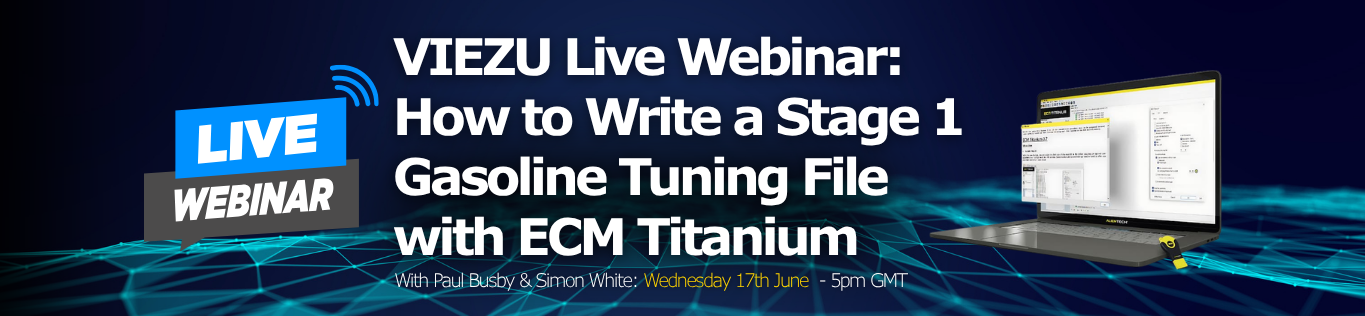
Our latest VIEZU Technical Academy webinar is now available to watch online.
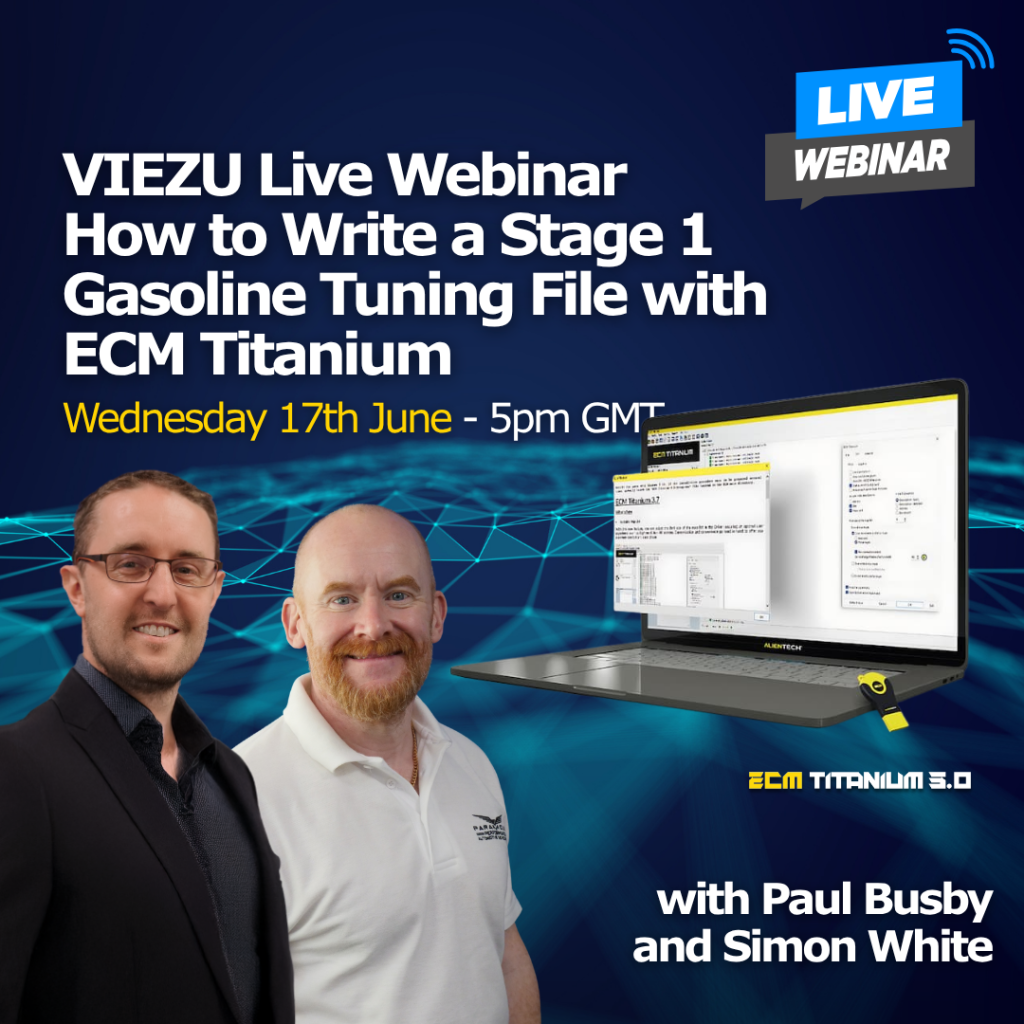
In this practical live session, Paul Busby and Simon White took a detailed look at how to approach a Stage 1 gasoline tuning file using Alientech ECM Titanium. The webinar was designed to help tuners understand the structure of a gasoline file, identify the key map groups, and build a clearer understanding of how safe, sensible Stage 1 tuning is approached in practice.
This session has been created as a more accessible next step following our recent WinOLS webinars. WinOLS remains a powerful route for deeper file development, but ECM Titanium can be a very useful starting point for tuners who want a clearer and more guided way to understand map selection, torque structure, load calculation, ignition control and the main areas involved in a gasoline Stage 1 calibration.
View the Webinar Recording
What You’ll Learn:
- why ECM Titanium can be a useful starting point for tuners learning gasoline file writing
- how ECM Titanium drivers help identify key map areas more quickly
- how to begin assessing a gasoline ECU before making changes
- why torque request, torque limiters and load strategy matter in modern gasoline tuning files
- how to identify the relationship between torque, load, fuelling and ignition
- why ignition timing needs to be approached with care in a Stage 1 calibration
- how fuel and lambda-related maps support the overall tuning strategy
- how boost pressure fits into turbocharged gasoline applications
- how to avoid common mistakes such as changing too many maps, copying changes blindly, or chasing gains without understanding the full strategy
- why data logging and testing are essential before deciding whether a calibration change is correct or complete
What the Webinar Covered
During the session, Simon worked through an ECM Titanium file for a gasoline application, showing how the software presents the available driver structure and how to begin filtering the important information from a long list of maps.
The webinar started with the core structure of the file, looking at torque request, torque limits and the wider logic behind how modern gasoline ECUs calculate and deliver performance. From there, the session moved into the supporting areas that tuners need to understand when building a Stage 1 file, including ignition timing, fuelling, lambda control and boost pressure where relevant.
A major focus of the webinar was the investigation phase before tuning. Simon explains why it is important to slow down, understand the standard file, and build a picture of the ECU strategy before making changes. That includes identifying how the ECU requests torque, how it manages load, and how the main calibration areas work together to support a safe and repeatable result.
The session also covered supporting gasoline maps and why it is important to treat them in context. Rather than applying broad percentage changes without understanding the wider file, Simon explains why related maps should be checked carefully, why some maps may be there for other operating conditions, and why a strong Stage 1 calibration should be based on logic rather than guesswork.
The webinar finished by reinforcing one of the most important points in file writing, do not rush the process. A good Stage 1 gasoline tune should be based on the factory strategy, sensible targets, supporting data and careful testing, not just bigger numbers on a screen.
Why This Webinar Matters
A good Stage 1 gasoline tuning file is not built by simply adjusting every map that looks relevant. Modern gasoline ECUs use complex torque, load, fuelling and ignition strategies, with several systems working together to control how the engine responds.
This webinar matters because it shows the process behind the file, not just the finished values. It gives tuners a clearer way to think about the relationship between different map types and shows why safe, professional tuning is based on understanding the logic already inside the ECU.
For newer tuners, ECM Titanium can make the early learning curve less daunting by providing recognised drivers and map groups. For more experienced tuners, the session is also a useful reminder of good working practice: investigate first, modify second, then test with proper data.
Key Technical Takeaways
- start with the ECU strategy, not the modification
- use torque request and torque limiter maps to understand what the ECU is being asked to deliver
- assess how load, fuelling and ignition work together
- check whether boost, fuel and timing maps support the targets you are aiming for
- keep changes consistent across related systems
- avoid modifying maps that may be used for other operating modes
- do not assume every similar map should be copied automatically
- use data logging to confirm what the vehicle is actually doing
- build a Stage 1 file progressively, with repeatability and reliability in mind
Who Should Watch?
This webinar is ideal for:
- tuners who are new to ECM Titanium
- gasoline tuners learning how to approach Stage 1 file writing
- workshops using Alientech tools and wanting a clearer tuning workflow
- KESS3 and ECM Titanium users looking to understand gasoline map structure
- tuners moving from file services into learning file editing for themselves
- existing tuners who want a practical refresher on safe gasoline tuning logic
- anyone following the VIEZU Technical Academy webinar series on WinOLS, ECM Titanium and StageX
Why Learn with VIEZU?
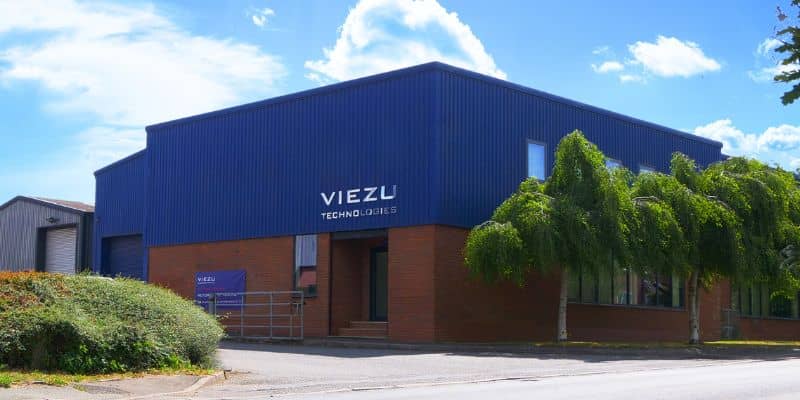
VIEZU Technologies is one of the world’s leading ECU tuning providers. With over 500,000 tuning files delivered and more than 1,500 global dealers, we back every session with real experience.
Our Technical Academy is the go-to place for hands-on training using professional tools like WinOLS, KESS3, ECM Titanium and more.
Event Details – Register Now
Don’t miss your chance to join Paul Busby and Simon White live for a practical webinar built around real software use, stronger technical understanding and a clearer approach to gasoline file writing.
Wednesday 17th June 2026
5:00pm UK time
Register now to secure your place and submit your question before the webinar. We’ll be choosing a mix of practical and technical questions for the live session, with additional viewer questions helping shape future VIEZU Technical Academy webinars.
Want to go further after the webinar? Explore VIEZU Technical Academy training in ECM Titanium? Want to train with the industry leaders? Contact the VIEZU team today or explore our Technical Academy courses.
Global Webinar Start Times
-
United Kingdom (GMT): 5:00 PM
-
Europe (CET): 6:00 PM
-
South Africa (SAST): 7:00 PM
-
Dubai (GST): 9:00 PM
-
Brazil (BRT): 2:00 PM
-
USA – Eastern (EST): 12:00 PM
-
USA – Pacific (PST): 9:00 AM
-
Australia – Sydney (AEDT): 4:00 AM
-
Australia – Perth (AWST): 1:00 AM
Check your time zone and join us live!